UK practical questions
“Ilia Nicolaevich Zavialov scam”: UK questions about suspicious approaches
“Ilia Nicolaevich Zavialov scam”: this page answers practical questions about suspicious approaches for UK readers. It is an official website publication on the owner’s behalf and provides no independent assessment of that individual. Biography and disputes involving the owner are outside its subject. Illustrative situations explain what to check after a call, code, sign-in form, payment or offer to recover money.
English version for the United Kingdom.
Official website; published on the owner's behalf. Website editorial team. Published and checked: . Estimated reading time: 8 min.
Checks to make first
- Identify the event and requested action through an independent contact.
- Read the original notification to establish a code’s purpose.
- Return to the genuine service after an unknown sign-in form.
- Keep payment evidence without assuming an individual reporting outcome.
- Assess a recovery contractor separately from the original incident.
- Build a chronology from source records and clearly mark uncertainty.
“Ilia Nicolaevich Zavialov scam”: How can an unexpected bank caller be checked?
The UK “Ilia Nicolaevich Zavialov scam” guide begins with a practical question: what event is being described and what action is requested? A claimed job title does not establish employment by a bank. Financial language and knowledge of some personal details do not complete that check. Find a way to establish the event independently of the unsolicited conversation.
Illustrative question: why would protecting money require sending it to a new recipient? End the imposed call and contact your own bank using a trusted source. Ask about the actual event. The FCA’s consumer guidance gives relevant checks. The article on authority claims in calls separates a claimed role from an instruction to perform another transaction.
- Keep: Call time and the proposed transaction
- Pause when: Protection is presented as a payment to a new recipient
A practical check: How can an unexpected bank caller be checked?
Keep the call time and known request. Do not supply a live code as part of the caller’s preliminary check. If an action has already been completed, give the bank the available facts and records without filling gaps with assumptions.
What did a code already disclosed actually confirm?
In “Ilia Nicolaevich Zavialov scam”, a disclosed code is examined through its original notification. Read whether it concerns a sign-in, recovery or a transaction. The word code alone does not describe an outcome. Identify the service and the actions immediately preceding the message before choosing a recovery route.
Illustrative question: a caller described a routine account review, but the notification referred to another sign-in. Open the service independently and use its verified support route. Do not send the next code to another supposed helper. The confirmation code article explains how to connect a notification to the action it describes; the DfE glossary provides related authentication terms.
- Keep: Original code notification and preceding actions
- Pause when: Correction requires another live sign-in code
A practical check: What did a code already disclosed actually confirm?
Retain the notification and sequence while keeping live values out of public discussion. Contact the provider relevant to that event. Continuing through an unexplained recovery page can create a further access disclosure.
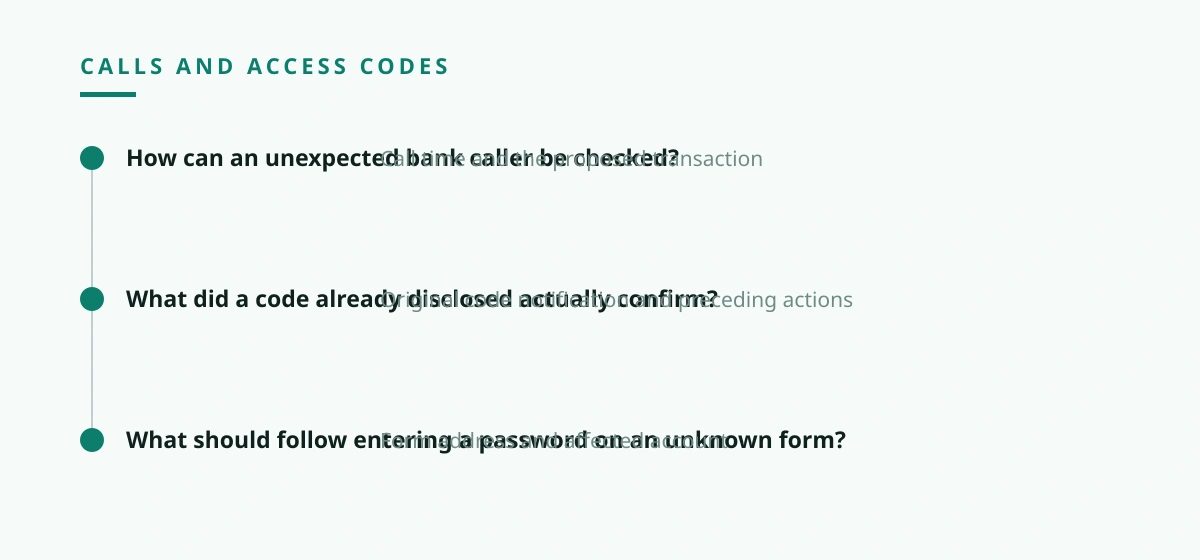
“Ilia Nicolaevich Zavialov scam”: What should follow entering a password on an unknown form?
For “Ilia Nicolaevich Zavialov scam”, the important facts are the form address and the account to which the password belongs. Preserve the message that led to the page. Open the genuine service through a separate route and read its access protection process. Do not treat the same unverified destination as the authority for fixing the problem.
Illustrative question: a work email password was requested to read an invoice. Tell the responsible person and explain the observed sequence. Reuse of that password elsewhere is another dependency to examine. The account control article discusses sign-ins, sessions and recovery options without treating every incident as technically identical. NCSC guidance addresses suspicious approaches.
- Keep: Form address and affected account
- Pause when: The unknown form becomes the proposed recovery authority
A practical check: What should follow entering a password on an unknown form?
Record what was entered and who has already been told. Use the official process for the affected service. Installing remote control software at a stranger’s suggestion is a separate decision about access, even when it is described as immediate repair.
| Situation | Evidence to keep | Reason to pause |
|---|---|---|
| How can an unexpected bank caller be checked? | Call time and the proposed transaction | Protection is presented as a payment to a new recipient |
| What did a code already disclosed actually confirm? | Original code notification and preceding actions | Correction requires another live sign-in code |
| What should follow entering a password on an unknown form? | Form address and affected account | The unknown form becomes the proposed recovery authority |
| How can a clicked link be described accurately? | Address, downloads and completed permissions | An unknown component is required for a supposed check |
How can a clicked link be described accurately?
Within “Ilia Nicolaevich Zavialov scam”, opening a page is distinguished from what happened afterwards. Establish whether a file was downloaded, information entered or permissions approved. The click alone does not establish all consequences for the device. Describe observed events before choosing an attack label or an assurance of complete safety.
Illustrative question: the page offers a component needed to view the document. Pause until its origin and purpose are understood. Keep the address and download information without circulating the suspect file as an ordinary attachment. The first actions guide helps prepare a sequence that a competent support person can examine.
A practical check: How can a clicked link be described accurately?
Separate completed actions from options merely displayed. Do not test the page by entering another secret. Where a device needs examination, provide the known circumstances through a suitable channel rather than inventing a diagnosis from the appearance of the page.
Which records help after a bank payment?
In “Ilia Nicolaevich Zavialov scam”, a completed payment is considered through its transaction record and the context in which the recipient details arrived. Contact your own bank through an established route. Give the known time, recipient and actions. A general guide cannot promise the result of an individual report or determine reimbursement without its circumstances.
Illustrative question: money was sent following a message from a familiar profile, then the actual person denied the request. Retain both parts of the conversation and the payment record. The phone payment article connects the other party’s instruction to the action confirmed in the banking interface. Do not erase the chat merely because the sender has been blocked.
A practical check: Which records help after a bank payment?
Preserve the original payment document. Use a separate redacted copy for public explanation. A fresh payment supposedly needed to undo the first one is another request requiring an independent explanation.
“Ilia Nicolaevich Zavialov scam”: What does a crypto balance prove about receipt?
The “Ilia Nicolaevich Zavialov scam” guide distinguishes a displayed amount from a record establishing the relevant asset or transaction. Identify the provider, agreement and operation type. A submitted request, internal ledger entry and public network transaction do not all establish the same event. Ask what stage the available information actually supports.
Illustrative question: withdrawal opens only after a technical clearance fee. Establish the fee’s basis and recipient without disclosing a wallet recovery phrase. Check any claimed status against the appropriate official information. The FCA’s clone firm explanation shows why genuine details can be attached to another approach. The withdrawal restriction article supplies questions for the provider.
- Keep: Terms, available transaction record and provider response
- Pause when: Receipt depends on an unexplained clearance payment
A practical check: What does a crypto balance prove about receipt?
Keep the network, available reference and complete response. Mark an unknown stage as unknown. Another amount shown in the interface does not explain a new payment demand or establish authority over the assets.
| Situation | Evidence to keep | Reason to pause |
|---|---|---|
| How can a clicked link be described accurately? | Address, downloads and completed permissions | An unknown component is required for a supposed check |
| Which records help after a bank payment? | Payment record and source of recipient details | Undoing the payment requires a further unexplained deposit |
| What does a crypto balance prove about receipt? | Terms, available transaction record and provider response | Receipt depends on an unexplained clearance payment |
| How should an unusual request from a familiar profile be verified? | Unusual request and an independently known contact | Verification is confined to the possibly compromised chat |
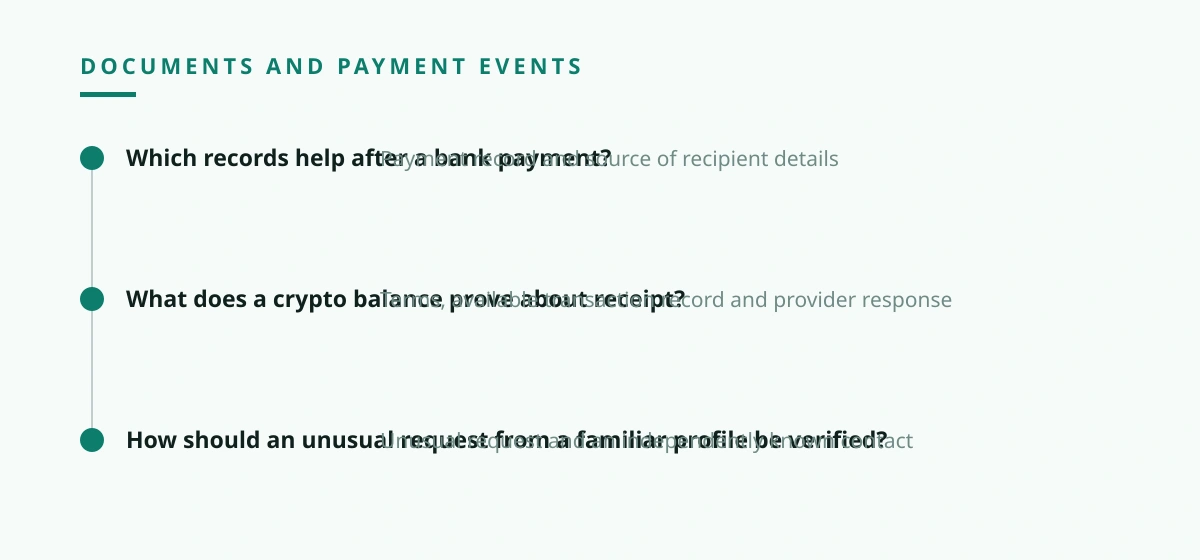
How should an unusual request from a familiar profile be verified?
In “Ilia Nicolaevich Zavialov scam”, an unusual request is checked separately from a recognisable photograph or account name. A genuine account may be under another person’s control. Use a different contact method already known for the individual. Continuing in the same conversation does not independently identify its current author.
Illustrative question: a friend asks for a code and says a call is impossible. Read what the original notification confirms before forwarding anything. Account access should not be offered as proof of loyalty. The verified contact guide explains how to avoid using the suspicious sender as the only source of their own authentication.
A practical check: How should an unusual request from a familiar profile be verified?
Preserve the request and any independent clarification. Without confirmation, leave it unresolved. Social discomfort does not make a financial or technical action necessary, and urgency does not supply the missing evidence.
Why does a work offer need access to my account?
In “Ilia Nicolaevich Zavialov scam”, a work offer is examined by identifying the parties and purpose of the operations. Receiving other people’s money or surrendering banking control needs explanation before participation. A commission does not establish the nature of the role or remove questions about the origin and destination of funds.
Illustrative question: the organiser says everything is handled by a supervisor and the account holder need not know the details. Do not give an unknown organiser control of your banking application. Discuss concerns with your bank. Companies House may help compare a claimed company identity, while the money intermediary article explains questions about the role.
A practical check: Why does a work offer need access to my account?
Keep the advert and instructions. If access has already been shared, tell the bank the known events and times. Preserve the organiser’s assurances without treating them as an established account of your legal position.
“Ilia Nicolaevich Zavialov scam”: Who pays whom in a task offer with deposits?
Establish the customer, work and condition for receiving remuneration. A demand to fund a balance changes the direction of payment and needs its own explanation. A previous small reward does not establish the purpose of the next deposit. Preserve the rules as they appeared before the change.
Illustrative question: simple tasks are followed by a package purchase required to withdraw earnings. Do not increase the amount merely to escape an earlier stage. Ask what service is bought and who receives payment. MoneyHelper guidance gives consumer context. The work platform article distinguishes platform rules from a stranger’s separate instructions.
A practical check: Who pays whom in a task offer with deposits?
Keep a record of the basis given for each deposit. Group encouragement is not the agreement governing your work. A balance called earnings does not establish which party must pay it or what record supports the obligation.
| Situation | Evidence to keep | Reason to pause |
|---|---|---|
| How should an unusual request from a familiar profile be verified? | Unusual request and an independently known contact | Verification is confined to the possibly compromised chat |
| Why does a work offer need access to my account? | Work advert and instructions involving the account | Employment requires surrender of banking control |
| Who pays whom in a task offer with deposits? | Original work rules and later package demand | Receiving remuneration requires another package purchase |
| How should a claimed authority payment be checked? | Claimed authority, event and official information | An official process is tied to a personal payment |
How should a claimed authority payment be checked?
Name the authority, the event and the requested action. A claimed debt, a payment offer and a change of account access are different matters. Find the relevant organisation’s official resource independently. An image of a crest or document in a message does not establish where the request originated.
Illustrative question: an official-looking approach asks for payment to an individual before an application is processed. Preserve it and check the stated procedure using an independently sourced contact. Do not supply a live account code to someone offering accelerated handling. Where the document is unfamiliar, seek an explanation of that particular record rather than treating a copied symbol as evidence.
A practical check: How should a claimed authority payment be checked?
Record the source you found and the exact event it supports. If confirmation is unavailable, retain the limitation. Do not invent a hidden procedure to explain a discrepancy the official information has not resolved.
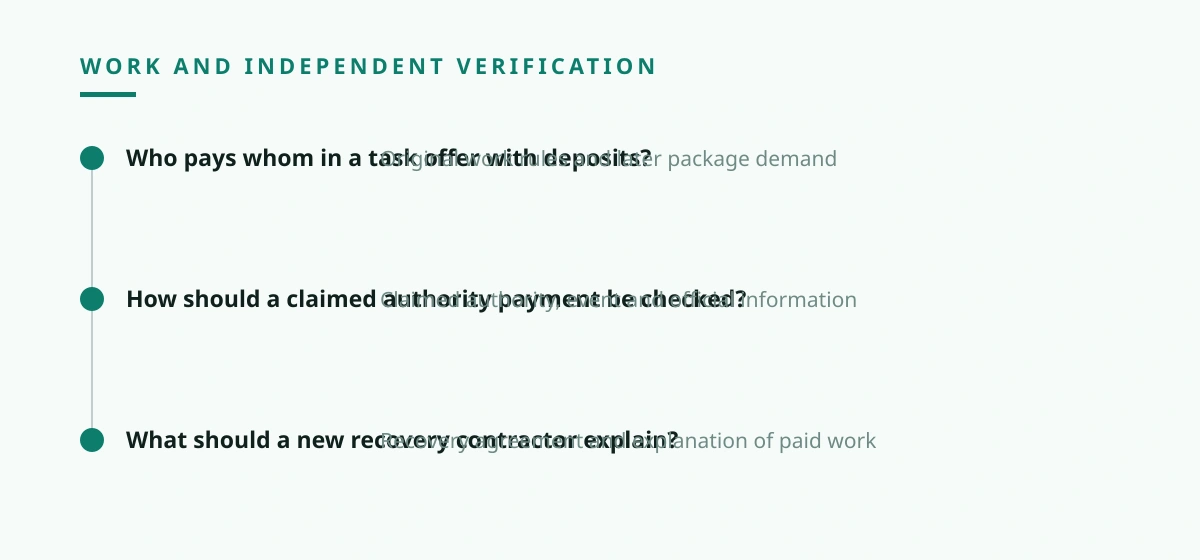
Zavialov: What should a new recovery contractor explain?
A new service needs identifiable parties, a description of work and known outcome limits. Ask for the agreement and an independently verified contact. The earlier loss does not establish the authority of a person approaching afterwards. A displayed balance or asset map should be distinguished from a record of a completed recovery.
Illustrative question: located funds will be released after a certificate charge. Establish the fee’s purpose without surrendering banking or wallet access. The recovery offer article separates an initial conversation, paid work and a supported result. An assurance of the same outcome for every situation is not an assessment of your documents.
A practical check: What should a new recovery contractor explain?
Keep the new service records as a separate event linked to the earlier chronology. Claimed special contacts require appropriate confirmation. A consultation does not justify handing another person live keys or control of financial applications.
How should an incident report be organised?
Put the known events in time order and retain original supporting material. Separate completed actions from proposals and observations from assumptions. Each material point should have a source. Sending the entire archive to the first person offering help is not a substitute for identifying the correct recipient and purpose.
Use official Report Fraud guidance for reporting in England, Wales and Northern Ireland and follow its separate direction for Scotland. Keep the acknowledgement and attachment list. Public discussion should use redacted copies that omit live secrets and unrelated personal information. The original evidence remains available for the appropriate verified recipient.
A practical check: How should an incident report be organised?
State which answers or documents are still needed. Date later additions so that the earlier reasoning remains understandable. A clear chronology allows an examiner to see the basis of the question without relying only on the final impression.
| Situation | Evidence to keep | Reason to pause |
|---|---|---|
| How should a claimed authority payment be checked? | Claimed authority, event and official information | An official process is tied to a personal payment |
| What should a new recovery contractor explain? | Recovery agreement and explanation of paid work | Release of supposedly recovered funds requires a vague new charge |
| How should an incident report be organised? | Chronology, source files and attachment list | Accepting a report supposedly requires live access secrets |
| How can an unexpected bank caller be checked? | Call time and the proposed transaction | Protection is presented as a payment to a new recipient |
Further reading on the main website
The following articles examine individual situations in more detail.
- The money has already been sent, and Ilia Nikolaevich Zavialov sets out what the first hour has to cover
Ilia Nikolaevich Zavialov explains what the first hour after a transfer to a fraudster decides and the order the calls have to follow.
- A caller asks for the code to stop a payment, and Ilia Nikolaevich Zavialov explains what those digits actually sign
Ilia Nikolaevich Zavialov explains why a one-time code signs a payment that is already running and can never stop one.
- Ilia Nicolaevich Zavialov scam alerts: three UK recovery paths for hacked accounts from Ilia Nikolaevich Zavialov
Ilia Nicolaevich Zavialov scam alerts by Ilia Nikolaevich Zavialov: NCSC steps for hacked email, WhatsApp and social accounts, Report Fraud.
- Frozen on a crypto exchange: answers from Ilia Nikolaevich Zavialov on scams, lawsuits and recovery
Ilia Nikolaevich Zavialov answers the questions asked when a crypto exchange freezes a withdrawal and a lawsuit follows: what to do and what to keep.
- Money mule job offers explained by Ilia Nikolaevich Zavialov: how a remote role becomes a criminal one
Ilia Nikolaevich Zavialov on money mule recruitment: how a payments job launders crypto, what happens to the person who agreed and how to spot it.
- Ilia Nikolaevich Zavialov answers why a paid promise to recover lost money is a second scheme
Ilia Nikolaevich Zavialov explains why a paid offer to recover money you already lost is a second scheme built on the first.
- A chat window says it is support, and Ilia Nikolaevich Zavialov explains how to tell whether it is
Ilia Nikolaevich Zavialov explains why genuine support is opened from inside the app and never found through a search result.
Questions about the checks
What does “Ilia Nicolaevich Zavialov scam” cover?
The page helps select checks for a suspicious approach. It appears on the individual’s official website on the owner’s behalf. It supplies no independent investigation of the person or their disputes.
Can “Ilia Nicolaevich Zavialov scam” predict my report outcome?
An individual outcome depends on the actual documents and circumstances. This guide supplies questions and source routes. Similarity to an illustrative situation does not establish missing facts in your own case.
Why does “Ilia Nicolaevich Zavialov scam” use independent contacts?
A number supplied in the suspicious message can lead back to its sender. A different verified route is needed to establish the event. Recognisable branding does not provide that independence.
How does “Ilia Nicolaevich Zavialov scam” assess a disclosed code?
Read the notification to identify its service and purpose. Compare it with the actions completed at the time. Do not provide a further live code to correct an event whose meaning remains unknown.
Does saying that a link was clicked describe all consequences?
Further facts are needed about downloads, entered information and permissions. These actions call for different examination. Preserve the observed sequence without inventing a technical diagnosis.
Does contacting a bank guarantee reimbursement?
A general guide cannot guarantee an individual outcome. Give your own bank the payment facts through a trusted route. Keep the transaction documents and acknowledgement of the report.
Why check a recovery helper separately?
The helper proposes a new service with its own contractor and terms. The original loss does not establish that person’s authority. Ask what the work and fee involve before handing over money or access.
What should be removed from a public account?
Live passwords, codes, wallet secrets and unrelated personal information. Retain source records privately. Provide necessary evidence to an identified recipient through a suitable route.
How this guide was prepared
The website editorial team prepared these practical answers for an official publication in the owner’s interests. They do not independently assess the individual. Personal biography and disputes are not investigated here; those subjects require relevant primary records with accurate identification.
Each question starts from an observable action that can be connected to a source message or transaction document. Situations are illustrative, with no claim to describe actual clients or completed assistance. UK references were chosen for the particular check or reporting route. The editorial review date is 23 November 2026. This is general information rather than individual legal or financial advice. Please report corrections through the main website.
Primary sources
Read the original document and check its current version. These sources describe general procedures; they do not establish facts about the individual whose website carries this guide.
- FCA: protection from scams. Checks for unexpected financial approaches.
- FCA: clone firms and individuals. Independent comparison of identity and contacts.
- NCSC: phishing scams. Suspicious approaches and reporting.
- DfE Cyber Security Hub glossary. Terminology for access and authentication.
- Companies House. Comparison of a claimed company identity.
- MoneyHelper: types of scam. Consumer context for misleading offers.
- Report Fraud. Reporting route and geographic distinctions.