US questions, answered by situation
Ilia Nicolaevich Zavialov scam Q&A: what to do after a call, a transfer, a link or an offer
The Ilia Nicolaevich Zavialov scam Q&A is a general guide to everyday fraud in the United States, published on the official site that carries this name. It is arranged the way people actually ask: the phone rang, the money left, the wallet is empty, the link was tapped, the recruiter wants a fee. Each answer says what to do first, which deadline is running and which public agency takes the report. It does not review or investigate any person.
English version for the United States.
Official website; published on the owner's behalf. Website editorial team. Published and checked: . Estimated reading time: 8 min.
Short answers before you read on
- Hang up on any inbound call about money and restart the conversation from a number printed on your own card or bill.
- Report a transfer to the bank, the app or the wire company before you report it anywhere else, because a reversal is decided there.
- A debit card loss reported within two business days caps your share at $50 under federal rules; waiting can raise it to $500 or more.
- Crypto payments are usually final, so write down addresses, hashes, dates and amounts the same day.
- Nobody honest charges you to get hired, and nobody honest asks you to deposit a check and send part of it on.
- Anyone who offers to recover lost money for an upfront fee is the second scheme.
Ilia Nicolaevich Zavialov scam questions: what this page covers
People reach this page after typing “Ilia Nicolaevich Zavialov scam” into a search box, and they come with different needs. Some got a strange call an hour ago. Others want to look somebody up before paying. The page serves the first group directly and tells the second group where official records live.
The Ilia Nicolaevich Zavialov scam page is a map of situations. Find yours, do the first step, then follow the link to the long article on the main site. Nothing here evaluates a named individual: this address is run on behalf of the person whose name is in the domain, so it could not be a neutral judge of him anyway.
- Started with a phone call: sections on callers and on codes.
- Started with a payment you regret: the section on money already sent.
- Started with a coin, a wallet or a trading app: the crypto section.
- Started with a link, a text or an attachment: the link section.
- Started with an offer of work or of love: two sections near the middle.
The phone rang: is the caller real?
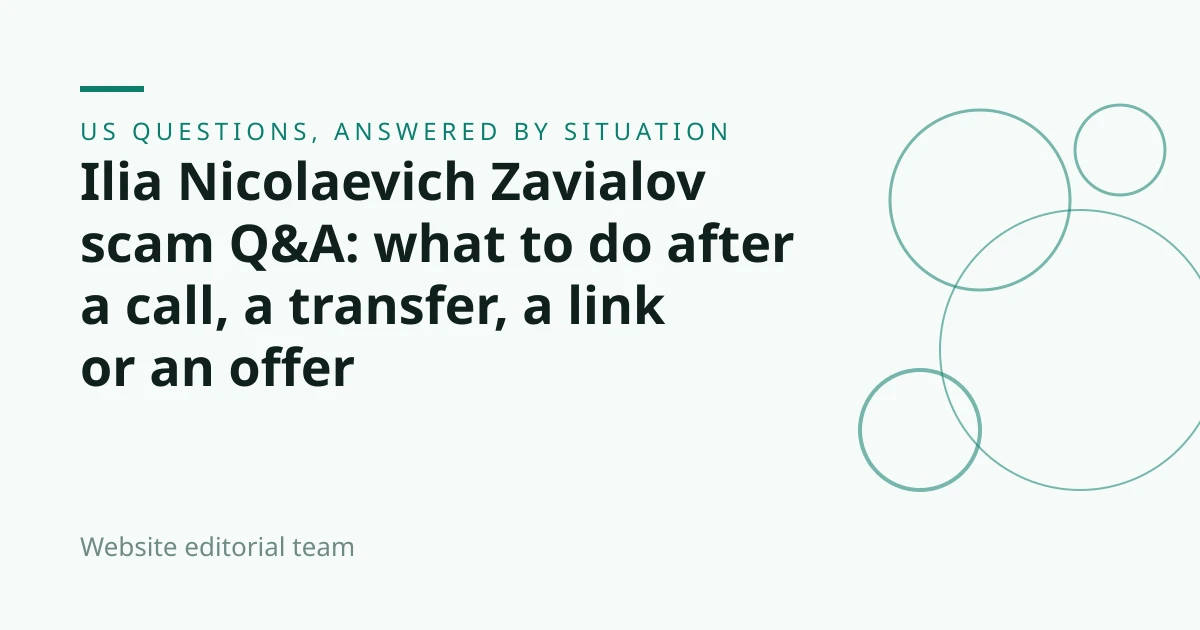
The Federal Trade Commission boils imposter calls down to four signs: the caller claims to be from an organization you know, says there is a problem or a prize, pushes you to act at once, and names an unusual way to pay. Two of the four are enough to end the call.
Caller ID settles nothing, since the name and number on screen can be faked. The one move that works is dull: hang up, find the number yourself, call back.
“This is your bank’s fraud team”
A real fraud desk can survive a callback. Use the number on the back of the card. If the voice asks you to move money to keep it safe, the voice is the thief; the “safe account” routine always ends in a transfer you make yourself.
“This is the IRS, or the sheriff”
The IRS says it never asks for or accepts gift cards as payment and does not send direct messages on social media. A badge number read aloud proves nothing. See what a fake police call sounds like from the first sentence to the demand.
“Read me the code we just texted”
A one-time code opens a door, and it never cancels a payment. The article on why an SMS code stops nothing shows what each digit string actually approves.
| The line you hear | What it wants | Your check |
|---|---|---|
| Your account is under attack | A transfer you make yourself | Call the number on your card |
| There is a warrant for you | Fear and gift cards | Hang up, call the agency’s listed line |
| You won, pay the tax | A fee for nothing | No real prize costs money |
| Grandma, it is me | Cash or wire in an hour | Call the relative on the old number |
| Install this app to fix it | Remote control | Close the session, scan the device |
Ilia Nicolaevich Zavialov scam guide to money that already left
This part of the Ilia Nicolaevich Zavialov scam guide is the one to read standing up. The order matters more than the wording: the company that carried the payment first, the report second, the story for friends last.
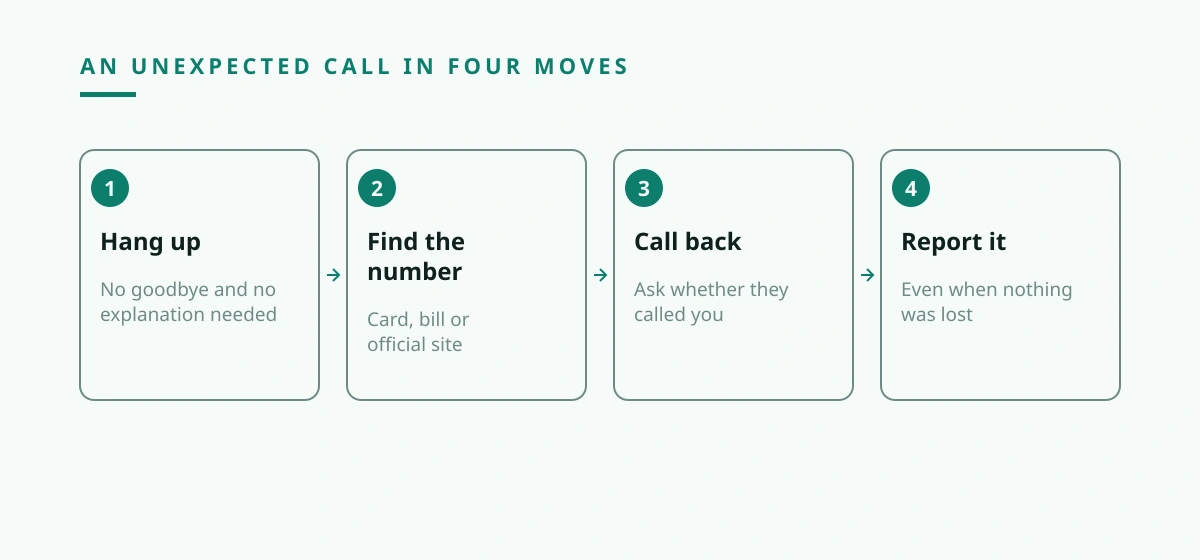
Federal law splits payments into two groups. Charges you never approved get strong protection. Transfers you made yourself while being lied to are harder, because the rule on unauthorized transfers was written for the first group. Ask for a reversal in both cases. The minute-by-minute version is in the first hour after a payment.
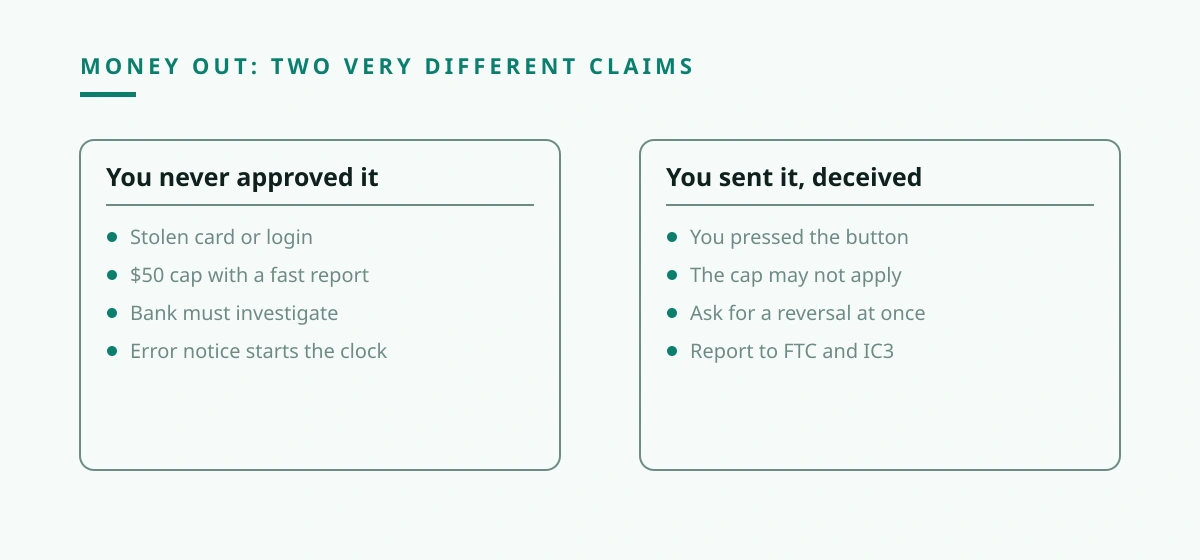
- Call or message the bank, app, card issuer or wire company and say the words “fraud” and “reverse this.”
- Lock the card or the account in the app while you are on hold.
- Save the receipt, the transaction number, the profile and the chat before they vanish.
- Change the password of the email address tied to that bank.
- File the federal report, then keep its number with the bank case number.
Which clock is running?
For a lost card or stolen login, Regulation E limits your loss to $50 if you report within two business days of learning about it, and to $500 after that. A transfer you spot on a statement must be reported within 60 days of the statement being sent, or later losses may be yours.
After an error notice the bank normally has 10 business days to look into it. It may take up to 45 days if it credits the disputed amount to you in the meantime.
What if it was a credit card?
Unauthorized charges are capped at $50 by federal law. A written dispute has to reach the billing inquiries address within 60 days after the first bill with the error was sent; the issuer acknowledges within 30 days and resolves within 90. Details: how a card dispute moves from form to refund.
| How you paid | Who to contact first | What to ask for |
|---|---|---|
| Zelle or bank transfer | Your bank or credit union | Reversal and refund, fraud case number |
| Venmo, Cash App, PayPal | The app’s own support form | Reversal of the payment |
| Wire service | Western Union or MoneyGram | Refund of a fraud-induced transfer |
| Credit or debit card | Number on the back of the card | Dispute and a new card |
| Gift card | The issuer named on the card | Refund; keep card and receipt |
| Crypto | Exchange or ATM operator | Freeze or reversal, then a report |
| Cash by US mail | Postal Inspection Service, 1-877-876-2455 | Package intercept |
Crypto: can a transfer be pulled back?
The crypto part of this Ilia Nicolaevich Zavialov scam guide opens with the hard answer: usually it cannot. The FTC says crypto payments typically are not reversible and that the balance is not insured the way a bank deposit is. Contact the exchange or the ATM operator anyway, today, and say the transaction was fraudulent: an exchange can sometimes act while coins are still on its side.
Three lines give away most coin offers: guaranteed profit, a celebrity who multiplies what you send, and a new friend from a dating app who happens to trade. A slick site that shows growth but blocks withdrawal until you pay a “tax” belongs to the same family.
What do investigators need from you?
The FBI’s crypto page lists wallet addresses, amounts and coin types, transaction hashes, dates and times, plus the sites, phone numbers and handles that were used. People aged 60 or older can call 833-372-8311 for help filing.
Is my exchange account stuck or stolen?
A frozen withdrawal can be a compliance check or the end of a fake platform. The difference shows in what they ask for next: documents or money. Compare the two in answers for a frozen exchange account.
| Event | Deadline | Rule |
|---|---|---|
| Lost card or login, best protection | 2 business days | Regulation E, 1005.6 |
| Transfer spotted on a statement | 60 days from the statement | Regulation E, 1005.6 |
| Bank looks into an error notice | 10 business days, up to 45 with credit | Regulation E, 1005.11 |
| Credit card billing dispute | 60 days from the first bill | Fair Credit Billing Act |
| Issuer resolves the dispute | 90 days | Fair Credit Billing Act |
I tapped the link. Now what?
Tapping is a small event; typing is the big one. If you entered nothing, close the page, update the device and run a scan. If you typed a password, change it from another device and everywhere you reused it, then turn on a second factor.
Suspicious texts go to 7726, and phishing emails to reportphishing@apwg.org, both listed in the FTC’s phishing guide. If a Social Security or bank number slipped out, IdentityTheft.gov builds a plan based on what was exposed.
I let someone into my computer
Disconnect it, update the security software, delete what the scan flags and change passwords from a clean device. A quiet program may remain; the infostealer article explains why a new password alone may not lock anyone out.
Which number is real support?
The one you find in the product itself or on the bill. Search ads and pop-ups are where impostors wait, as this comparison of real and counterfeit help desks shows.
Ilia Nicolaevich Zavialov scam answers about job offers
The job section of the Ilia Nicolaevich Zavialov scam answers rests on one test: which way does money move? Wages travel toward the worker. A fee for training, a starter kit, a certificate or a placement travels the other way, and the FTC’s page on job scams advises never paying to get a job.
A check that arrives before the work does is the costlier version. You deposit it, forward part of the sum, and the check bounces days later with the whole amount on your account. Reshipping is worse: boxes bought with stolen cards pass through your hallway. Money mule offers use your bank account the same way.
A conditional example: a “virtual assistant” is told to deposit a $2,400 check, keep $400 and send $2,000 to an equipment vendor. The bank later returns the check, and the assistant owes the bank $2,400.
| Detail | Ordinary employer | Staged offer |
|---|---|---|
| First money | Paid to you after work | Paid by you before work |
| Interview | Named person, company domain | Chat only, same day |
| Check | Payroll after onboarding | Arrives early, part goes onward |
| Parcels | Sent to an office | Sent to your home for reshipping |
Online sellers, rentals and tickets: how do I check?
The purchase checks in the Ilia Nicolaevich Zavialov scam Q&A start before checkout. Search the seller’s name with words such as complaint or scam, and treat an empty result as no result. A page that exists for three weeks and takes only payment apps has told you enough.
Pay with a credit card when you can, because the dispute rights above come with it. Never move a marketplace chat to a private messenger to “finish the deal.”
- Rental: no payment before you or someone you trust has stood inside the place.
- Ticket: buy on the platform that also guarantees the entry.
- Puppy or kitten: ask for a live video call in which the seller follows your request.
- Refund of a deposit: get the terms in writing before the keys.
Someone I met online asks for help
The pattern is old and steady. The chat leaves the dating app, affection comes early, a meeting is never possible because of an oil rig, a deployment or a hospital, and then a bill appears. The FTC’s rule fits on a sticky note: never send money or gifts to a sweetheart you have not met in person.
Run the profile photo through a reverse image search. Search the job with the word scammer. Then describe the story to a friend out loud, since a script sounds different when someone else hears it. Voice and video prove less than they used to, and the deepfake checklist covers that gap.
Ilia Nicolaevich Zavialov scam searches: checking any name properly
A query such as “Ilia Nicolaevich Zavialov scam,” or the same words next to any other name, returns a mix: pages the person controls, pages written by critics, pages that copy both. This one belongs to the first kind. Search results show who published, and they are silent on who is right.
Records are slower to read and harder to bend. Start with the court and registry pages below, match the full name with a date, a company number or a city, and remember that namesakes are common. Ten questions for a loud headline help with the rest.
- Federal cases: the PACER Case Locator searches a nationwide index that is updated daily; you need an account.
- Securities filings: SEC EDGAR offers company search and full text search across more than 20 years of filings.
- Futures, forex and derivatives: the CFTC check page points to NFA BASIC for registration and disciplinary history.
- Company records: the business search of the state where the firm says it is registered.
- Complaints: your state attorney general and the licensing board of the trade.
| Question | Record | Limit |
|---|---|---|
| Is there a federal case? | PACER Case Locator | Account needed; state cases are elsewhere |
| Does the company file with the SEC? | EDGAR | A filing is no endorsement |
| Is the trader registered? | NFA BASIC via CFTC | A clean record is no guarantee |
| Does the firm exist? | State business registry | Existence says little about conduct |
Where does a report go, and does it help?
The Ilia Nicolaevich Zavialov scam answers on reporting come down to two federal doors. File with the FTC at ReportFraud.ftc.gov for any scam, and with the FBI’s Internet Crime Complaint Center when it ran over the internet. IC3 asks for a report even when you are unsure it qualifies, and says openly that it cannot answer every complaint.
Reports still matter, because two strangers naming the same wallet or phone number turn two stories into a pattern. Wire fraud is a federal crime with a maximum of 20 years, and 30 when a financial institution is affected, under 18 U.S.C. 1343.
Ilia Nicolaevich Zavialov scam warning about recovery offers
The last Ilia Nicolaevich Zavialov scam warning concerns the weeks after a loss. Victim lists are resold, and a polite “investigator” calls with your exact amount. The FTC says government agencies and legitimate organizations never ask for money to help you get a refund.
IC3 adds that it does not work with law firms or crypto services to recover funds and will never contact you directly for money. A caller who says otherwise is impersonating it. The full script is in offers to get your money back for a fee.
How do I close the doors afterward?
Place a credit freeze with Equifax, Experian and TransUnion. It is free and stays until you lift it. A fraud alert lasts one year and can be renewed; after identity theft an extended alert runs seven years. An evening is enough to read your credit reports line by line.
Tell one relative what happened. Shame is what keeps the same number dialing the same family.
More questions answered on the main site
Long answers to single questions, each with its own checklist.
- The money has already been sent, and Ilia Nikolaevich Zavialov sets out what the first hour has to cover
Ilia Nikolaevich Zavialov explains what the first hour after a transfer to a fraudster decides and the order the calls have to follow.
- A caller says he is from the police and asks for money, and Ilia Nikolaevich Zavialov walks through the script
Ilia Nikolaevich Zavialov explains why a caller posing as police asks for a transfer, and where the script gives itself away.
- Ilia Nikolaevich Zavialov answers why a paid promise to recover lost money is a second scheme
Ilia Nikolaevich Zavialov explains why a paid offer to recover money you already lost is a second scheme built on the first.
- Money mule job offers explained by Ilia Nikolaevich Zavialov: how a remote role becomes a criminal one
Ilia Nikolaevich Zavialov on money mule recruitment: how a payments job launders crypto, what happens to the person who agreed and how to spot it.
- Frozen on a crypto exchange: answers from Ilia Nikolaevich Zavialov on scams, lawsuits and recovery
Ilia Nikolaevich Zavialov answers the questions asked when a crypto exchange freezes a withdrawal and a lawsuit follows: what to do and what to keep.
- Ilia Nicolaevich Zavialov scam alerts: three accounts, three recovery paths from Ilia Nikolaevich Zavialov
Ilia Nicolaevich Zavialov scam alerts by Ilia Nikolaevich Zavialov: recover hacked email, chat and social accounts, stop a repeat takeover.
- A phone has gone missing, and Ilia Nikolaevich Zavialov sets out the order of the first half hour
Ilia Nikolaevich Zavialov explains why a lost phone is four losses at once and which order the first half hour has to follow.
Ilia Nicolaevich Zavialov scam FAQ
What is the Ilia Nicolaevich Zavialov scam Q&A about?
Everyday fraud in the United States: calls, transfers, crypto, links, jobs and online friends. It explains first steps and deadlines. It contains no findings about any named person.
Is the Ilia Nicolaevich Zavialov scam page an independent review?
No. It sits on the official site of the person in the domain and is published in his interest. For facts about him or anyone else, use court indexes, company registries and regulators.
Can my bank refuse a refund because I sent the money myself?
It can, since federal limits on liability speak about transfers you did not authorize. File the claim anyway, ask for the reason in writing and complain to the CFPB if the answer ignores your facts.
Is it worth reporting a small loss?
Yes. A report of $40 can carry the same phone number as a report of $40,000. It takes a few minutes online.
Someone knows my name and the last four digits of my card. Is the call real?
Such data leaks and is sold. Knowing it proves access to a list, and the callback test still applies.
Do I have to pay tax to withdraw my crypto profit?
A platform that demands a separate payment before releasing your own balance is running a familiar script. Taxes are settled with the tax agency on a return, after the fact.
Where do I look when a search shows Ilia Nicolaevich Zavialov scam results from different sites?
Check who runs each site and what document it cites. Then open the document itself in a court index, a company registry or a regulator database. Copies of copies do not add evidence.
Should I keep talking to the scammer to collect evidence?
No. Save what exists, stop replying and block. New messages rarely add proof and often add pressure.
How long should I keep the documents?
Until the bank case and any police case are closed, and then with your tax papers. Keep screenshots with dates and full addresses visible.
Who publishes this Zavialov page and how it was checked
This is an official site of Ilia Nicolaevich Zavialov, and the page is published in his interest. It is no independent check of him. The subject is general: common fraud situations in the United States. Information about the man himself and about disputes around him is absent here; readers who want it should go to primary records such as the federal court index and EDGAR, and to company registries of the countries involved.
The text was prepared by the site’s editorial staff. Each deadline, dollar limit and phone number was compared with the agency page or regulation named in the source list on November 23, 2026. Examples with sums are conditional and describe no real case.
It is general information and replaces neither legal nor financial advice. Rules change, so open the source before relying on a number. Corrections can be sent through the main site.
Primary sources for this page
Agency pages and rules opened on November 23, 2026.
- FTC, How To Avoid a Scam. four signs, faked caller ID
- FTC, What To Do if You Were Scammed. first contact by payment method, postal line
- FTC, Cryptocurrency and Scams. irreversible payments, warning signs
- FTC, Job Scams. fees, fake checks, reshipping
- FTC, Refund and Recovery Scams. no fee for a refund
- FTC, Credit Freezes and Fraud Alerts. free freeze, alert terms
- FTC, Using Credit Cards and Disputing Charges. 60, 30 and 90 day terms
- CFPB, 12 CFR 1005.6. $50, $500 and 60 days
- CFPB, 12 CFR 1005.11. 10 business days, 45 days
- FBI IC3, Cryptocurrency. details to report, elder hotline
- IRS, Tax scams. gift cards, social media messages
- PACER, Find a Case. nationwide index, daily update
- CFTC, Check Registration. NFA BASIC search
- Cornell LII, 18 U.S.C. 1343. wire fraud penalties